Interview with Ovanes Akopyan
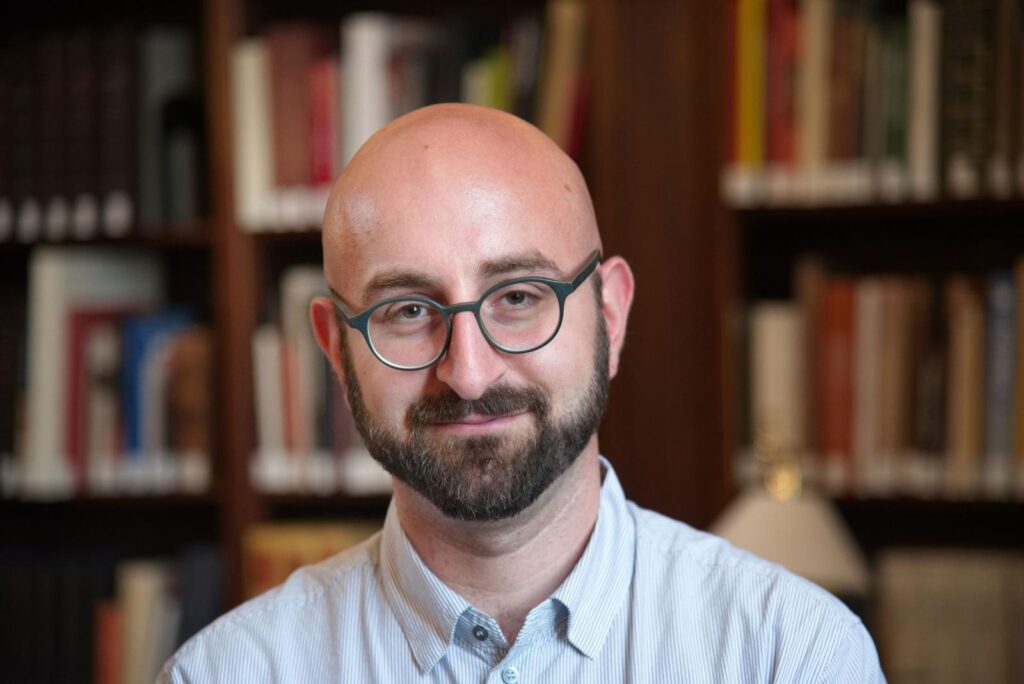
Ovanes Akopyan recently joined the Institute of Philosophy as a Research Associate and is one of several international scholars currently working at the Institute. His research focuses on the Renaissance, intellectual history, and the history of science.
- Ovanes, we are delighted to have you here. Could you briefly tell us about your academic journey? How did you come to join the Institute of Philosophy?
Thank you for having me. It has indeed been quite a journey. By training, I am an intellectual historian: I studied first at Lomonosov Moscow State University, then moved on to a PhD at the University of Warwick. After the UK came a long postdoctoral odyssey – first to Austria, at Innsbruck University, closely tied to its renowned Ludwig Boltzmann Institute for Neo-Latin Studies, and then to Italy: first at Villa I Tatti, the Harvard University Center for Italian Renaissance Studies, and later as a Marie Skłodowska-Curie Fellow at Ca’ Foscari University in Venice. My research interests have ranged rather widely – from the history of the astronomical sciences, and above all the Renaissance rejection of astrology, to environmental thought and Russia-Europe relations in the early modern period. At first glance these may look like disparate pursuits, but part of my work has been precisely to show how deeply intertwined they are. I have also written on scholars very familiar to Croatian readers, such as Petrić, Boscovich and De Dominis. My hope at the Institute is to deepen my engagement with these fascinating figures and situate them within the broader context of early modern philosophical culture – particularly around the themes that have preoccupied me most lately: the environmental thought of early modernity, theories of tidal motion, early modern engagement with the element of water more generally, and the history of astrology.
- How have you settled into life in Zagreb? And what has your experience of the Institute been like so far?
It’s been lovely, in every sense. My wife, our five-year-old and I have taken particularly to the parks and to everything that comes with them – something we sorely missed in Italy. Zagreb, by contrast, is green and unhurried, and we finally have the chance to enjoy that kind of life properly. We’re still finding our way around, but so far, so good.
As for the job, it really is a dream position. To be perfectly honest, over the past three years – while applying for positions, grants and everything else that keeps an academic afloat – I had accumulated a considerable backlog of projects I simply hadn’t had time to finish. This position has finally let me clear it. In five months, I’ve completed four articles, two reviews, a book, and nearly finished the draft of another. Not so bad. And needless to say, I very much hope to repay the Institute’s hospitality, and this remarkable opportunity, in kind.
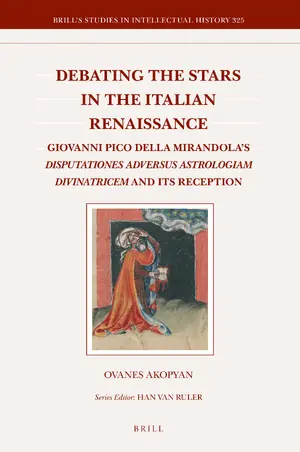
- Your book Debating the Stars in the Italian Renaissance (2021) examines the controversies sparked by Giovanni Pico della Mirandola’s Disputationes adversus astrologiam divinatricem (1496). What made these debates so significant? Why did Renaissance thinkers attach such importance to astrology?
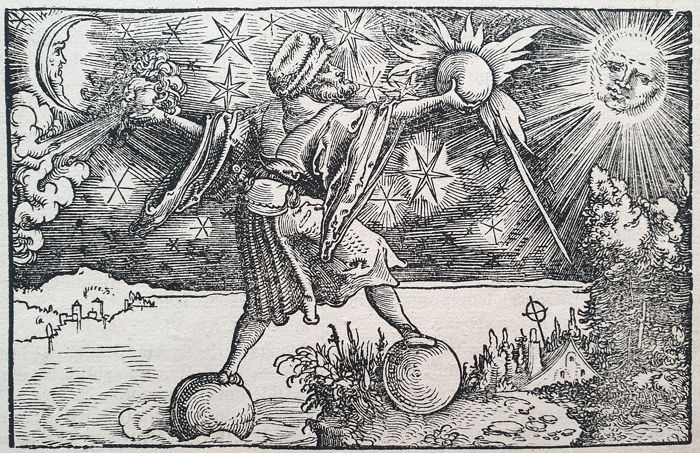
There are many layers to that story. Back then, astrology was nothing like the discipline we know today – by no means was it dismissed as mere charlatanism. Quite the opposite: since the earliest times, it had been considered a legitimate and highly respectable field of knowledge. Of course, plenty of scholars criticised it, for various reasons – on religious grounds, since it was thought to limit divine omnipotence, and also because it was recognised as inherently conjectural, meaning astrologers could simply get things wrong, which cast doubt on the profession as a whole. But despite such criticisms, astrology was endorsed for centuries by some of the most eminent intellectuals of antiquity, the Middle Ages and the Renaissance. After all, some of the greatest figures of the so-called scientific revolution – a term that has come under considerable scrutiny in recent years – were practising astrologers: Tycho Brahe, Johannes Kepler, Galileo Galilei. For several of them, reforming astronomy, not least by championing the Copernican system, mattered just as much as reforming astrology, which was regarded as mathematics’ practical application and, on a more serious, metaphysical level, as the sign – very tangible, very practical – of divine presence in the universe.
Which brings me back to my book. I argue that Pico’s work was emblematic of how Renaissance scholars perceived astrology as a discipline. What matters is that Pico – one of the most brilliant and celebrated philosophers of the Renaissance – had not always been sceptical of it. Quite the contrary: he once considered it a vital field of knowledge, closely tied to what he regarded as the highest of the natural philosophical disciplines and the key to knowing the divine – the Kabbalah, that is, Jewish mysticism, which, in Pico’s view, Christians ought to adopt in order to better understand their own doctrine. To the young Pico, astrology stood just one rung below that most sacred of mystical disciplines. And yet, he later changed his mind, and my book tries to explain why.
There has been no shortage of speculation about his motives. Was it Girolamo Savonarola’s influence – the infamous religious radical of the late fifteenth century? Or have we simply misread the evidence, and did Pico in fact endorse some form of astrology throughout his entire life? Or is the text we take as proof of his anti-astrological stance even genuinely his – given that the original manuscript is lost, and what survives is an edition prepared, from a now-lost and rather poor autograph, by his nephew Gianfrancesco Pico della Mirandola, himself an ardent follower of Savonarola? My own conclusion is that Pico’s arguments developed independently of Savonarola’s views – if anything, the influence ran the other way – and emerged instead as a response to a range of intellectual currents circulating in 1490s Florence. Seen in this light, the genesis and argumentation of the Disputationes are emblematic of the intellectual culture of the period: written just a few decades before the Reformation, amid the devastation of the Italian Wars and the other formidable challenges Renaissance philosophers had to reckon with, one way or another.
There is one more twist to the story. The Disputationes was published posthumously in Bologna in 1496 – the very year, and the very city, in which Nicolaus Copernicus arrived to continue his studies. As Robert Westman has argued, Copernicus was surrounded throughout his life by astrologers, including his teacher at Bologna and his sole pupil, Rheticus. So the question becomes: to what extent might the publication of the Disputationes have shaped Copernicus’s decision to advance the heliocentric system – an idea he had already encountered in Kraków – as a way of reforming not just astronomy but astrology too? I have recently been working on the first English translation of the Disputationes, and I hope to develop this into an ERC project examining precisely how the “marginalisation of astrology” occurred in early modernity – though I confess I have my doubts about that very term.
- You have published extensively, but one of your works is of particular interest to readers in Croatia: Francesco Patrizi da Cherso: Ancient Wisdom, Natural Philosophy and Poetics in the Late Renaissance, published in a 2019 special issue of Intellectual History Review. How would you assess Petrić’s place in the history of European philosophy and, more broadly, in European intellectual history?
He truly is a fascinating figure, and for more than one reason. For a start, he embodies the central preoccupations of the most educated scholars on the southern side of the confessional divide: the vernacularisation of knowledge, the prisca theologia, the anti-Aristotelianism, and a good deal besides.
Second, Patrizi was essentially what Giordano Bruno, so often portrayed as the great champion of Renaissance philosophy, actually wanted to be. He was, if you like, the successful Bruno: someone who proposed a comprehensive, all-embracing philosophical system of his own – arguably the first such attempt since the scholastic era, which is precisely what Bruno also tried to do – but who, unlike Bruno, actually succeeded, with all the nuances that entails, both as an academic and as a scholar who was read, acknowledged and genuinely debated by his contemporaries. Those are the ingredients of a major figure, and Patrizi was undoubtedly a towering one in the late sixteenth and early seventeenth centuries.
What strikes me, though, is that despite these remarkable achievements, he has remained curiously underappreciated. I can speak here for the Anglophone scholarly world and some continental traditions: even though there are some excellent studies of Patrizi and his legacy, it is telling that there hasn’t been a major single-authored study of him in English for God knows how many years. Part of the answer, I think, is that philosophy itself has been in crisis as a discipline, and even its trendy new application to AI development is unlikely to change that, I’m afraid. In such a climate, Renaissance and early modern philosophy is hardly a priority, and figures like Patrizi end up unfairly neglected. The second obstacle is more practical: writing seriously about Patrizi demands a real command of several languages, Latin above all – and we all know the state of language learning these days.
I should confess that I am currently writing a new entry on Patrizi for the Stanford Encyclopedia of Philosophy, which has given me real appreciation for how much our fellow scholars have done lately to deepen our understanding of his thought – I only hope my own contribution does some justice to their work. But to move things forward in any substantial way, the natural next step would be a comprehensive monograph on Patrizi. Whether I am the one to write it, I honestly couldn’t say – but I hope my years at the Institute of Philosophy will prove useful on that front too.
- Among other things, Kronika aims to provide a space where researchers can present their current work. What are you working on at the moment, and what can we look forward to from you in the near future?
Alongside the encyclopedia entry and the various things I’ve already mentioned, I’ve been working on a cluster of articles on a subject that has interested me for some time: the tides. I’ve just finished a long article on early modern theories of the tides, tracing how they shifted gradually from an astrological framework towards a more mechanistic one. Among other things, I argue that one significant, and largely overlooked, aspect of this shift was the convergence of theory with a practical need: the need to contain high tides and bring nature under some measure of control. I show that by the late sixteenth century, the astrological interpretation had largely vanished among university-based or government-affiliated scholars – it lingered on in some form, but mainly among those without ties to government or an established position within the academy – precisely because it offered no mechanism for putting theory into practice. It strikes me as a fascinating episode in the history of knowledge, one in which several major intellectual currents converge at once: the rise of environmental thought, the growing appetite for practical control over nature, and the broader mechanisation of nature itself.
There is also another project I have nearly finished – I am hoping to submit it to the publisher by November – which is somewhat removed from philosophy proper, but which has, unfortunately, become rather timely: it looks at images of Muscovy in early Renaissance European writing, and the Russian responses to them. The book, written for Harvard University Press’s I Tatti Studies monograph series and growing out of my time in Florence at I Tatti, shows that many of the mutual misconceptions between the two sides – misconceptions that have recently contributed to the disastrous and tragic events in Ukraine – have, in fact, been circulating for a very long time.
Interwieved by Ana Grgić