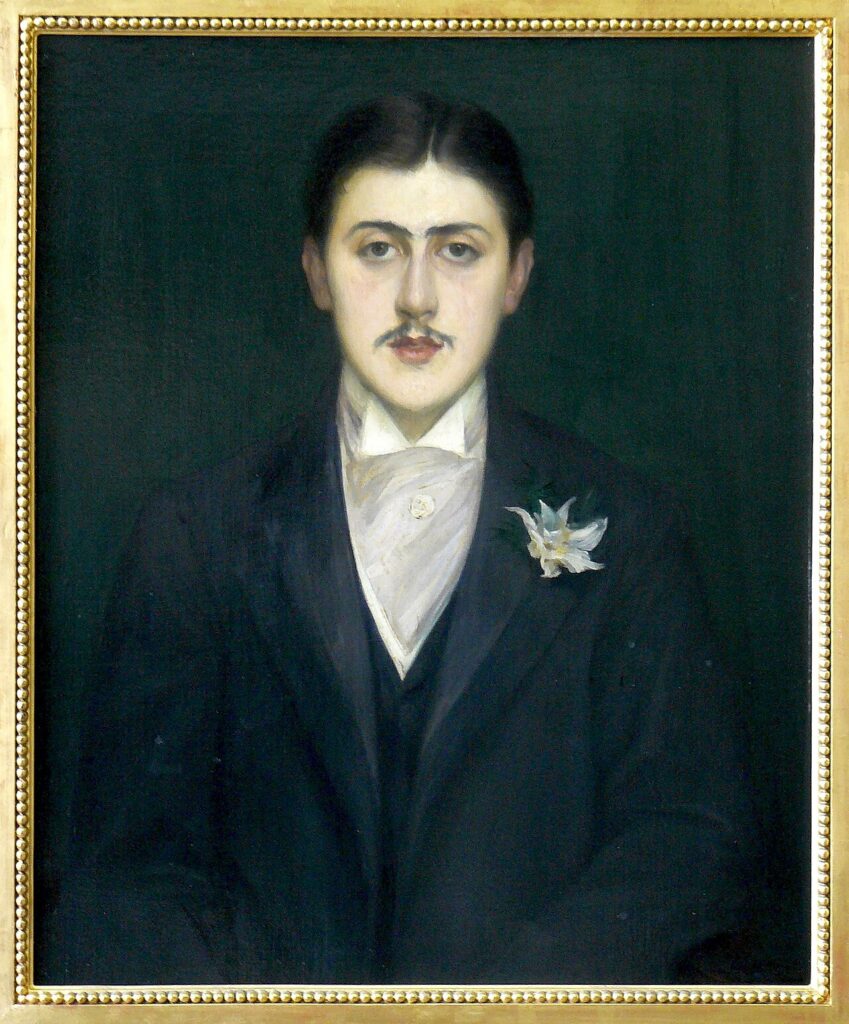
MATTHEW NINI
For a long time I went to bed early. In those days, Marcel would sometimes fall asleep so quickly that, from the moment he blew out his candle to the moment he passed into the world of dreams, there was hardly enough time to say “I’m falling asleep.” And then, a half-hour later, the thought that he should go to bed would wake him up. It’s time, he would say to himself, blow out the candle, close the book, and bury your cheeks into the soft cheeks of the pillows around you. And in this half-conscious state, he was not only able to find that moment that had been lost to him the first time, but prolong it and inhabit it; he could feel his own self, floating somewhere off in the distance. It seemed to him that he had become the subject of his bedtime reading: a church, a quartet, the rivalry between François I and Charles V. And just as a room bathed in daybreak slowly constitutes itself before the sleeper, first seeming to be a different place before finding its old shape, so the self comes slowly back to itself, and its old relationship to time. The sleeper holds in a circle around him the thread of hours, the order of years and worlds. He consults them instinctually upon waking, and in a second, sees where he stands in both time and space.
The opening lines of Marcel Proust’s seven-volume cycle of novels, In Search of Lost Time (À la recherche du temps perdu, 1913–1927), with their hesitation between sleeping and waking, reality and fiction, author and narrator, contain the whole novel in miniature. Who is the “I” who speaks to us from his sickbed, and where will his story bring us? Back to himself, of course – but only after having gone through a series of false selves that betray what was there from the start. And back to his sickbed, to the place of dreams and fabulations, first lived up close, and then recorded in the novel he was unable to write even as we read his own story.
Summarizing the Search is easy enough: Marcel becomes a writer. But nearly every word in that summary will be complicated by the author’s sense of time. Who, first of all, is this Marcel? Not quite the work’s historical author, Marcel Proust. Nor is he an entirely fictional construct; he is born out of the author’s reflection on his own authorship. Still, he is a single character who constellates many ulterior versions of himself, a person who stands opposite one author. Just as Marcel Proust novelizes his novel-writing, so will Marcel the narrator reflect on who he has become, passing through the stages of his own development like a set of Russian dolls. Time is the thing that unites all of these versions of Marcel. Yet Marcel’s very becoming in time is interrupted by the narrative of his experience.
Written in high-modernist style, the Search does not tell a linear story; nor are all of its components of equal weight. A gifted observer, Marcel is able to transform a few seconds’ worth of action into pages of material – five notes in a sonata or the flight of a bee occasion his deepest reflections on his own life. At other points, whole decades are passed over with a simple paragraph break. The relationship to time is troubled not only through these changing speeds, but through direction. The last version of Marcel, the writer who has shut himself up in his room, seeks to regain time lost by writing his life, transforming it into fiction. This decision, portrayed in the dizzying present-moment of the closing pages of the book, is the highest point of perspective we achieve, and the real beginning of the Search.
And indeed, from the very beginning of the first volume, Swann’s Way, there are real affinities between the last volume and the first, full of allusions to things to come – facts that the narrator already knows, but that we do not, yet without which the story makes no sense. This is perhaps why so many readers return to Swann’s Way after having read the whole cycle: the fullness of experience is in repetition. One has not understood Proust’s Search until one has repeated it, and remembered it for oneself.
* * *
Let us return, then, to those opening pages, the narrator caught between sleeping and waking, wondering whether he is the reader or what is being read. For a moment, he thinks that he is in the house of Mme de Saint-Loup (and in Proustian fashion, we are about to meet Mme de Saint-Loup for the first time, but long before there is any indication she will become what she will be), it is already ten o’clock at night, his nap has gone on for far too long, and he is late for dinner. He will have to dress quickly.
As he comes to himself and realizes that it is the middle of the night and he is at home, it becomes clear that this is a moment of repetition. The structural similarities of waking up, the same whether one is in this place or that, bring forth an involuntary memory. More than a mere recollection, this makes a moment from the past physically present: in the body of the narrator, the moment itself comes back to life. The effect is lived in the body, and identified in writing: there, we encounter the future (Mme de Saint-Loup) before her past (her childhood self in Swann’s Way). It is the jolt of bodily experience, the sensation that occurs in the blink of an eye, united to the past through writing, that is the real repetition of the novel. The point of these seven novels, then, is to juxtapose time past, time present, and time future, watching them as they come together in an unbidden moment of sensory experience.
The collision of past and present that elicits a future implies a malleable conception of the self. Not only our narrator, but all the people around him, too, are in a constant state of transformation. Nobody in the Search is exactly who they seem to be; their social status, beliefs, and appearance all transform over time, each person a kind of Theseus ship, zig-zagging through the narrative. Who are they? the narrator asks himself, and who am I? Is there anything unchanging about us, anything holding us together other than a name?
* * *
The first part of the Search chronicles the social aspirations of Marcel as he moves through the salons of the Parisian aristocracy. Social climbing has replaced the youthful ambition to write, and while our narrator rarely speaks himself, his social graces allow him to ascend to ever more stratified spheres. It is in this context that hundreds of the Search’s distinct characters come to be known to us. Among them, we are introduced to Mme Verdurin, whose petit-bourgeois salon and comical snobbery are the object of Marcel’s ridicule; the Marquise de Villeparisis, a refined bluestocking who serves as counterpoint to Verdurin, and the first step in Marcel’s social climb; Robert de Saint-Loup, a member of the Guermantes family who is gallant, friendly, progressive, and well-read; the Baron de Charlus, an egotistical and abrasive figure; and finally, the Duchesse de Guermantes, whose beauty and noble spirit are the archetype of the aristocratic world for which the narrator longs. She is a kind of worldly Beatrice, ensconced in the drawing-room of her hôtel particulier, an inner sanctum to which Marcel will gain access only after years of social climbing.
Here is where the first fault-line in the narrator’s identity appears. Marcel Proust the writer is a master of pastiche, and the baroque social protocols of Parisian high society often descend into the ridiculous; worse still, the eccentricities of the salon regulars make the reader ask why one would visit them in the first place – other than for comic relief. Still, Marcel the narrator is blind to the ironies of the salon world, viewing it through a kind of romantic prism, the product of his own snobbery. The snob is the person who has filtered reality through the lens of social status, sacrificing aesthetic judgment to bon ton. Marcel will arguably never be cured of snobbery – even in his final iteration, as the reclusive author who, in a Schopenhauerian gesture, renounces worldly life, racing against time to produce a great work of art before death comes for him, he enjoys the descriptions of salon life so palpably that he could not have rejected it entirely. But he will gain an ironic distance from his snobbery, and it is this distance that will allow him to see the uglier part of high society: the conversation is often vapid, its partakers usually superficial and sometimes cruel. The realization that social climbing cannot be an existential substitute for writing will happen piecemeal, following the temporal ebb and flow of the Search. There is, however, a moment early on that foreshadows it, providing the basic structure of Marcel’s disillusionment with the upper set: the encounter with a woman known simply as la Berma. It is only an encounter in a one-sided, almost voyeuristic sense: la Berma is the most famous stage player in the narrator’s world, and is modelled on Sarah Bernhardt (1844–1923), perhaps history’s first international celebrity actress. As an adolescent, Marcel longs to see Berma interpret Racine’s Phèdre (1677), one of the great tragedies of the French theatrical repertoire. Forbidden by his parents to go to the theatre because of his fragile health, he spends hours reconstructing Berma’s performance through a playbill, a pamphlet by his favourite writer, and stray bits of conversation. Yet, when he is finally allowed to see her on stage, chaperoned by his grandmother, he is sorely disappointed. A merely human actress with a merely human voice, she fails to produce the transcendent effect of which Marcel had dreamed.
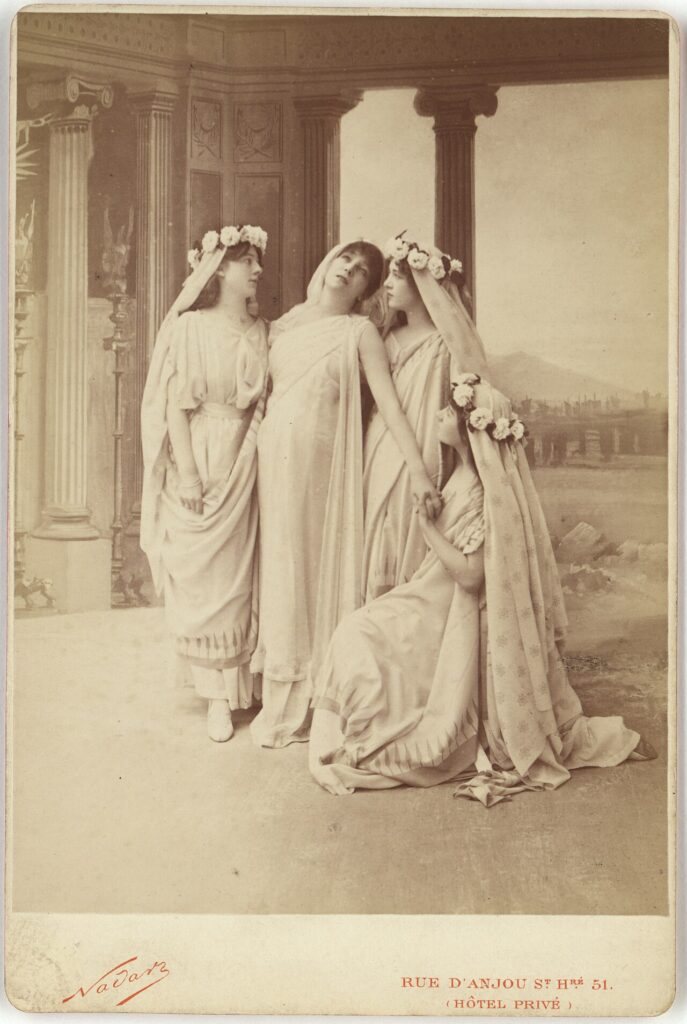
The J Paul Getty Museum, Los Angeles.
A sustained reflection on the nature of art will ensue. After some time, Marcel will acknowledge that art, as artifice, has constraints. The talent of an artist should be judged by their ability to work within those constraints. And on that criterion, la Berma is indeed an exceptional artist. Importantly, the experience has a “before,” “during,” and “after,” with the bodily experience of being in the theatre marking the point of rupture. The “during,” the physical experience of sitting in the theatre and hearing Berma’s voice, causes an inner rift, a delineation in Marcel’s felt experience of time; there is now a before and an after, with the “before,” the past, subjectively coming into being when the fantasy in which he had lived is destroyed. The inner crisis that ensues then happens all at once (the moment that Berma opens her mouth) but is then inhabited for an extended period of time. The crisis must be worked through in order for a future, an “after,” to present itself – ironically, one that is a reappropriation of the naïve “before.”
* * *
The pattern established at the theatre will repeat itself again and again in the Search, with an embodied crisis moment causing a rift in Marcel’s subjective sense of time. Its most tragic – and most decisive – instance is the death of Albertine. What began as a summer romance at a seaside resort descends into obsessive jealousy, with Marcel spying on every meeting and conversation of his beloved, in love with her because he cannot have her completely. Nor can he confirm his greatest fear – that she is really a lesbian, and having a romance with precisely the girl he has sent to spy on her. We love what we cannot possess entirely, opines the penultimate, narrating voice of Marcel, as if from afar. And what the earlier, infatuated version of Marcel cannot have is access to Albertine’s inner life. Then she disappears. Without saying goodbye, she flees. As Marcel’s servant, Françoise, dryly announces, Mademoiselle Albertine has gone. The inevitable is then followed by the tragic: Albertine dies suddenly in a riding accident in the countryside. Marcel is informed by telegram. In a kind of Proustian reversal, the moment of rupture that creates the past, while still being a physical event, is not directly experienced by the narrator. It is portrayed negatively, through sudden and then permanent absence. It is in this void that the crisis will be experienced at length, with fits of jealousy continuing after Albertine’s death, followed by the horror of forgetting her.
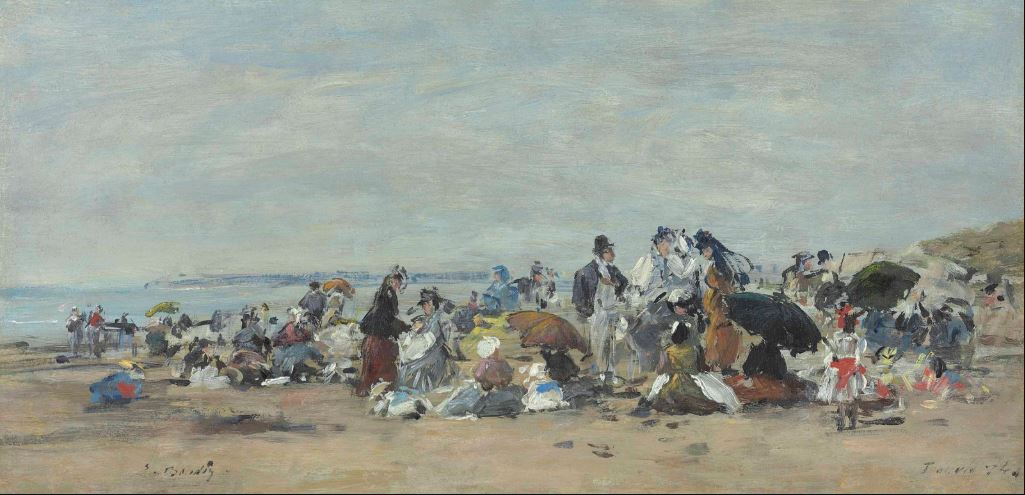
Yet it is precisely absence that will serve as a healing balm, and rectify Marcel’s relationship to time. The distance that the death of Albertine provides is ultimately generative of the narrator’s own subjectivity. Too close to his own desires to see what they were, Marcel experiences the removal of the beloved as a sort of inaugural rupture. Distance allows him to see that jealousy itself is an endlessly repetitive refrain, repeating that of Charles Swann in the self-standing retrospective from the first volume, Swann in Love. His own suffocating obsession had, like a Greek tragedy, caused him to resign himself to tragic repetition.
The emergence of his subjective desires after Albertine’s death culminates in his own physical absence from Paris – the trip to Venice of which he had dreamed for so long, the Bildungsreise that would teach him how to see beauty, had been constantly postponed during his fit of jealousy. At that time, the trip was seen merely as an absence, a condition for Albertine’s sapphic dalliances. Yet it is precisely this absence that is the beginning of his own artistic consciousness. When a telegram arrives at Marcel’s Venice hotel, with Albertine’s signature, declaring I am alive, I want to marry you, the thought that Albertine has spoken beyond the grave does not bother him for very long. He dismisses it as a postman’s mistake, and hands it back to the porter. Love, like social climbing, will also be lost to time, unable to provide lasting comfort. Yet something else, still indistinct, opens up: in the Accademia picture gallery, a painting by Carpaccio evokes Albertine in a strange, sensual way: a cloak that Albertine once wore is evoked by one seen in the picture. Through a present physical experience, Albertine is confined to the past (her coat was like that once), an act of noticing that opens up a future.
Yet Venice, the voyage meant to teach Marcel to see, still belongs to the realm of the ideal, having furnished numerous impressions, but other than the recognition that Albertine no longer moves him, none of them find their place in the temporal succession of his life. Did he really see Venice? Some time later, he opens a volume of the diary of the Goncourt brothers, only to discover a description of an event that brought together a cast of characters he knew well. He had barely noticed any of the things chronicled by the literary socialite brothers, and came to the conclusion that he does not know how to observe. The jumble of inner impressions he experiences when looking at the world are his alone, and the real world of events, the place where time passes, is foreign to him. He decides to renounce ever becoming a writer.
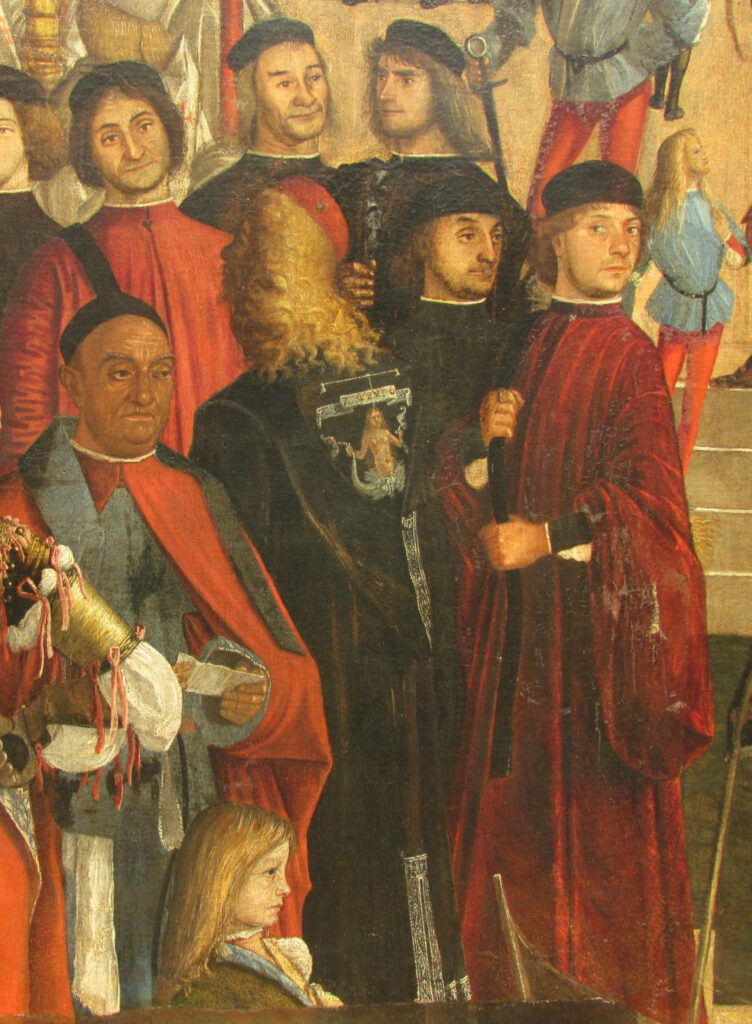
Vittore Carpaccio, Galleria dell’Academia, Venice.
Resigned to idealism, Marcel will eventually be overtaken by time and world. The intensification of chronic illness leaves him confined either to bed or sanatoriums for years. In Proustian fashion, these historical, external events are passed over in a few sentences. When, years later, Marcel emerges from his sickbed, invited to an afternoon party, a matinée, organized by the Princesse de Guermantes, the world into which he is reintroduced is changed almost beyond recognition.
These changes had already begun in Venice. There, Mme de Villeparisis was covered in eczema, and her legendary wit descended into the comic in the presence of her lover, the doddery ambassador Norpois. The world had then only begun to change. By the time Marcel arrives at the Guermantes’ afternoon, the social order has been entirely upended.
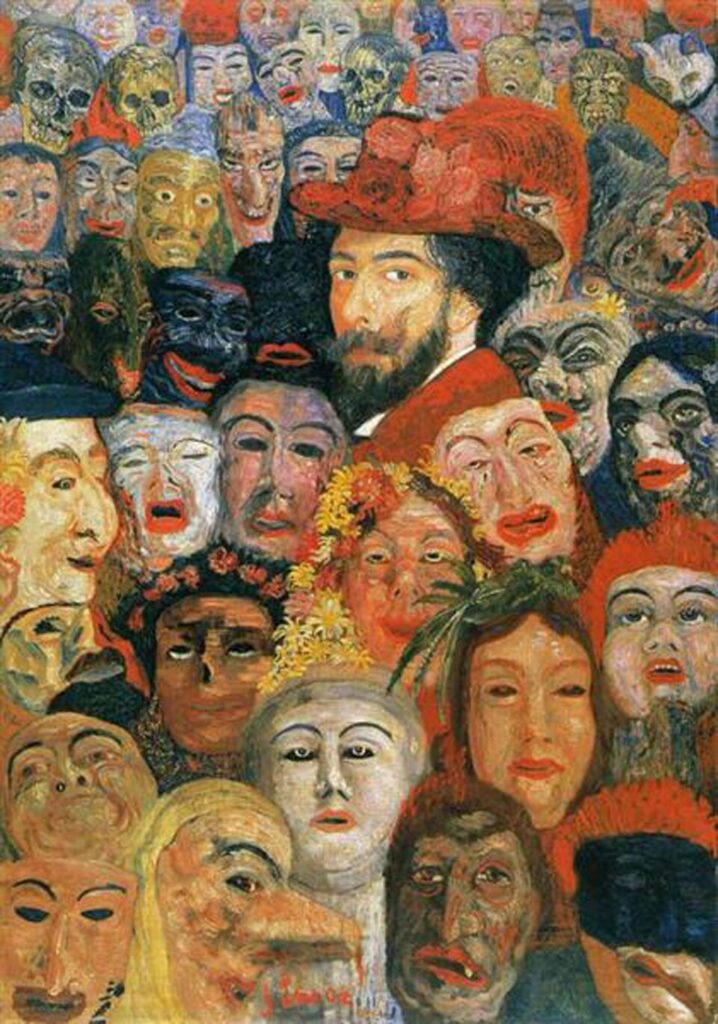
His hostess, the Princesse de Guermantes, is in fact Mme Verdurin, now the wife of a prince after an improbable third marriage, now outranking the much-admired duchess of the same family. The Baron de Charlus, once the epitome of the French aristocrat, becomes a defeatist Germanophile during the war, obsessed with the obscure Germanic branch of his lineage. In his last appearance, in the street as Marcel is on his way to the Guermantes’ matinée, he is aged and senile. Robert de Saint-Loup was first a proponent of Dreyfus, and a progressive and generous man. He then becomes an anti-dreyfusard, snobbish and cruel. The last time we see him, shortly before he dies on the front fighting for France, he is humming a Schumann song in the stairwell, something boyish about him once again. Not only is nobody who they were; nobody has remained faithful to the very essence of who they used to be. The aging crowd is so powdered and made-up that Marcel wonders whether he is attending a masked ball. If the names had not remained the same, he would not have recognized any of them. If illness were not enough to kill Marcel’s social ambitions, this vision of an elderly gathering of aristocrats, no less superficial for no longer being beautiful or brilliant, certainly was.
* * *
The Guermantes’ matinée is the completion of the transformation that began in Venice. Not in the sense that it is a moment of deeper absence and misplaced impressions, but instead, one where what is lost is finally found again, earning it a proper place in memory. The crisis moment that brings this about will happen at the threshold of the salon. In the time that it takes to pass from the courtyard to the library where he will wait to be admitted, a series of sensory encounters – small happenstances that usually would have gone unnoticed – will evoke a memory. When remembered, what was initially a random impression gains meaning through what the French literary theorist Roland Barthes calls “a collusion between past and present.” It is this secret agreement between past and present that will open up the possibility of a future that is not alienated from the past self and present self, but a continuation of them.
Associating a fragment of the past with a sensation in the present is an experience that somehow stands outside of time; and it is through just such an experience that time can be regained. This is not some mystical state in which time stops; rather, it is an instant in which Marcel notices that his subjective experience of time goes beyond the bounds of measurable time. Not only is he an individual in time; time is also in him, and its two felt instants, past and present, meet at the signpost that is the self. The mechanism of this “collusion” is involuntary memory, its archetypal instance occurring near the beginning of the first volume. As Marcel softens a madeleine biscuit, with its distinctive seashell form, in a cup of tea and distractedly brings it to his lips, a strange, pleasing sensation overwhelms him. The memory behind it resists, but eventually comes to the surface: it is Sunday morning, he is in Combray, at his aunt Léonie’s country house, and she has offered him a madeleine soaked in tea, as she did every Sunday. This, the most famous moment in the Search, offers us only its method, not its meaning. For while seven volumes would seem to emerge involuntarily out of a cup of tea, they are in fact the product of a writer’s craft. And it is only at the Guermantes’ doorstep, near the end of the last volume, Time Regained, that memory has its vindication.
It is Marcel’s first worldly outing in a long time. And by the time he enters the salon, he knows that it will be his last, giving the whole event an aura at once beautiful and melancholic. Upon arriving, as he walks across the uneven tiles in the outer court, he experiences the same feeling as when he crossed the uneven pavement in the baptistry of Saint Mark’s in Venice. As he enters the cloakroom, a servant tells him that an ensemble is playing, and he should wait in the library so that his arrival does not disturb the musical performance. There, he is brought something to eat and drink. As a spoon hits unintentionally against a plate, he is reminded of a train trip in the countryside, as a railwayman’s hammer had tapped against the wheels of a stationed locomotive. After drinking from a glass of orangeade, he brings a cloth serviette to his mouth, and its stiffness reminds him of the towels at the hotel in Balbec, the seaside town where he spent two summers, and met Albertine.
In all three cases – the pavement stones and Venice, the spoon and the railway journey, the serviette and Balbec – a physical sensation evokes not a concrete memory, but rather a feeling. Time’s achievement is not the evocation of a past event, but the resurrection of a feeling that is simultaneously past and present, seeming to stand outside of time. Recognizing that feeling can be resurrected in this way is itself a kind of memory, a remembering that one has remembered, that provides its own pleasure.
This last realization will lead Marcel to a radical decision: he must leave the world and consecrate himself to writing. For if memory of memory is also pleasurable, and is always accompanied by some specific pleasurable memory, it should be possible to make the involuntary voluntary: to juxtapose sensations in writing will evoke the pleasure they produced. The “collusion” can be provoked in language, and others can share in it.
Marcel knows this because his life as a reader has taught it to him. Before he enters the salon, facing a world full of finitude and passing sensations, he takes a book from the shelf. It is George Sand’s novel François le Champi. This is the book that his mother read to him in the first childhood scene of Swann’s Way, the foundational moment of Marcel’s consciousness. Both he and his mother are immersed in the bucolic world that Sand has created. Mother, child, and author share the pleasure of evoked sensation in a kind of literary communion. This sensation is much stronger than pleasure. This, the feeling that writing can transcend finitude, that it merits renouncing the world, and that it is both companion and stimulus in the face of sickness and death, is something else – consolation.
Recommended Reading:
Marcel Proust, À la recherche du temps perdu, ed. Jean-Yves Tadié, 4 vols, Bibliothèque de la Pléiade (Paris: Gallimard, 1987–1989).
Marcel Proust, In Search of Lost Time, gen. ed. Christopher Prendergast, trans. Lydia Davis, James Grieve, Mark Treharne, John Sturrock, Carol Clark, Peter Collier and Ian Patterson, 6 vols (London: Allen Lane, 2002).
Marcel Proust, U traganju za izgubljenim vremenom, trans. Tin Ujević et al., 13 vols (Zagreb: Zora, 1965).
Recommended Listening:
Roland Barthes, “La leçon de Proust selon Roland Barthes”, Series : Proust Aujourd’hui. RTF radio programme, 09.12.1963.
Matthew Nini is Research Associate at the Institute of Philosophy in Zagreb. He is author of The Book of Nocturnes and most recently, Schelling and the Ages of the World.